
The Updated Italian Keyboard is a keyboard layout designed to meet the orthographic requirements of the Italian language. Compared to the standard Italian keyboard, the Updated Italian Keyboard has a few but significant differences, such as the presence of accented capital vowels, angled quotation marks, hyphen or the ordinal indicator of the feminine gender.
The Updated Italian Keyboard also offers an easy mode for entering characters combined with diacritical marks used in Western languages based on the Latin alphabet.
This site sets out every detail related to the use of the Updated Italian Keyboard and distributes a free downloadable software implementation of it.
COS’È «TASTIERA ITALIANA AGGIORNATA»
È una disposizione di caratteri…
Typed with Updated Italian Keyboard
COS'E' "TASTIERA ITALIANA AGGIORNATA"
E' una disposizione di caratteri...
Typed with standard Italian keyboard
The Updated Italian Keyboard was developed to address the shortcomings of the standard Italian keyboard, which, paradoxically, does not include in its character set some of the characters needed to write in Italian!
Among the missing characters, the most important are the uppercase e with a grave accent (È), as well as double angled quotes (« »).
To workaround the limitations of the standard keyboard, users employ some tricks they’ve learned through word of mouth or by searching for solutions online. Among these, the main ones are: entering the code for the desired character using the numeric keypad while holding down the Alt key, or using the Character Map function in Windows.
Far less widely applicable is the use of the spell-checking feature built into some word processing programs: it analyzes the entered text and “corrects” character sequences deemed to be incorrect. For example, the sequence E' may be corrected to È, the sequences << and >> to « », and so on. However, there are several reasons to consider this solution unsatisfactory. The main one is that the spell checker is not a tool integrated into the operating system—that is, capable of intervening in response to any keyboard input—but is present only in a limited number of programs; outside of these, it will still be necessary to resort to the workarounds already mentioned. Furthermore, even within those programs, the feature is not ubiquitous; that is, it may not be available in certain contexts, such as text boxes in dialogs. In addition, spell checkers sometimes “correct” more than the author of the text would like, and for this reason, it is not that uncommon for them to be disabled. Most programs, however, lack this feature, not because they are functionally deficient but due to deliberate design choices aimed at preserving the input data exactly as provided. Last but not least, we must consider the long-term detrimental effect of spell-checkers, which—by distracting users from the need to understand the difference between correct and incorrect spellings—will encourage the spread of the latter, with the predictable result that errors such as E', un pò, perchè, sè, nè will be tolerated as errors on the part of the writing program rather than being considered negligence on the part of the writer.
These considerations—and others I have omitted to keep this from becoming too lengthy—highlight the fact that the standard Italian keyboard is incomplete, and the workarounds for its shortcomings are complicated and not entirely satisfactory. With the Updated Italian Keyboard, writing flows naturally without relying for aids such as spell-checkers or any other tricks.
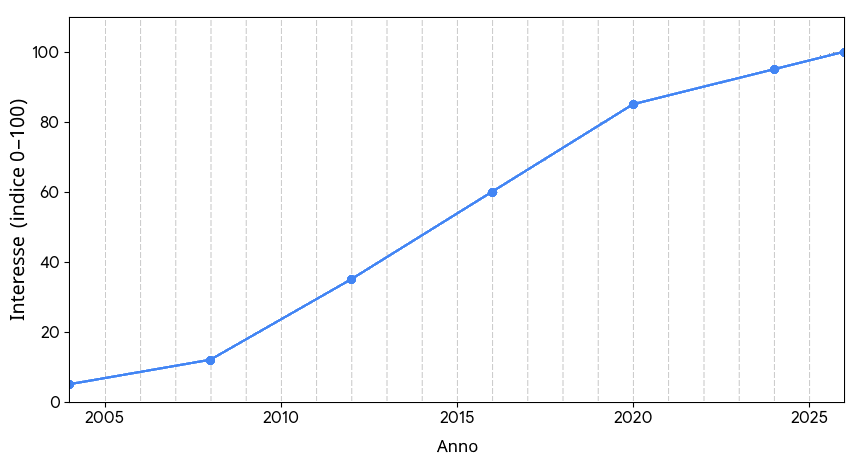
Interest in time for the search term “uppercase accented e” (source: Google)
The sharp increase between 2008 and 2020 is likely due to the growing popularity of blogs and social networks, which have helped raise awareness among users about the importance of spelling rules. Currently, the frequency of this search is at an all-time high.
In the Updated Italian Keyboard, the layout of the characters on the keys is designed to minimize discrepancies with the legends on the keys of standard Italian keyboards. The Updated Italian Keyboard is therefore easy to use when paired with a standard Italian physical keyboard.
In addition to meeting all the spelling requirements of Italian, the Updated Italian Keyboard implements a mechanism of layers triggered by specific key combinations, which allows users to type any word in European languages using the Latin alphabet. The mechanism, which is quite intuitive to use, allows to combine letters of the alphabet with a set of diacritical marks.